


welcome to
wild
In this issue we meet the people who’ve turned our Aussie wildlife into obsession, into a way of life: photographers, researchers, and adventurers who notice what most of us walk past. Learn how Emma at the Australian Reptile Park turns lethal funnel-web spiders into life-saving antivenom, or follow marine scientist Lawrence as he hunts elusive reef dwellers you’d never think exist. From tiny, solar-powered sea slugs to eagles in the sky, and peacock spiders that dance like they own the backyard, this is a look into the weird, the wild, and the wonderful corners of Australia’s natural world.
Look closer. It’s more incredible and occasionally more dangerous than you think.

WILDLIFE ISN'T ALWAYS IN YOUR FACE
Sometimes it’s underfoot, flicking through the grass, or hanging out where you least expect it. The more you notice, the more the ordinary turns extraordinary and the people in this issue live for exactly that. Slow down, watch closely, and prepare to see what most of us just walk past.
understanding

the wild we live with
When I was a kid, wildlife was something you lived with.
We’d raise hatchling turtles in makeshift ponds, watching them grow strong enough to return to the water. Turtle ponds would transform into an aviary for orphaned frogmouth owls we’d found beneath their nests. The odd snake, sniffing a little too close to the house, would need relocating. It was all just part of growing up.
We became obsessed with reptiles. Entire days were spent hours from home on sprawling properties, scanning tree trunks for lace monitors and turning over rocks in search of rare scorpions. As I got older, that curiosity didn’t fade - Weekends meant bush walks with a spotlight, sweeping the dark for nocturnal animals and insects most people never realise are there. That naturally turned into years of tour guiding travellers: snorkelling reefs by day, spotlighting wildlife around camp by night.
In Australia, for many kids, this is normal. In regional towns, on farms, even on the edge of cities, you grow up knowing what shares your space. Learning what’s in your backyard can feel just as important as anything in a textbook. And in a country that outsiders love to describe as “where everything wants to kill you,” that knowledge matters. Understanding wildlife replaces fear with respect. It teaches you what to step back from, what to admire, and what simply needs space.
If there’s one thing I’d encourage, it’s this: slow down. Spend a little more time observing. Not just at your destination, but on the walk between. From camp to the toilet block. From the car to the lookout. Once you start noticing the movement in the trees, the insects underfoot, the rustle in the grass, you’ll never walk past it again.
- Jayden

Across Australia, there are people who’ve taken that same instinct and turned it into a way of life.
Mariella and Dougal are two of them, following wildlife wherever it leads and documenting the encounters that most travellers drive straight past.
HOOKED ON THE WILD
WITH BROTHER NATURE
For many travellers, Australia’s wildlife is a bucket-list experience. For Mariella and Dougal, it became a way of life.
Mariella moved from Italy to Australia 11 years ago. She met Dougal better known as “Brother Nature” in his hometown of Airlie Beach while they were completing a Divemaster internship. They quickly became dive buddies, and before long, as Mariella puts it, it turned into a real “divemance.”
From the beginning, Dougal’s passion was undeniable.
“I remember thinking, what is this guy doing here? He should be on TV in a wildlife documentary or something like that.”
When COVID halted overseas travel in 2019, the pair decided to turn their focus inward toward Australia itself. Camping had always been their reset button, so the idea of buying a caravan and travelling full time didn’t take much convincing. They picked up their van in August 2021 and hit the road a month later.
Since then, they’ve travelled through Channel Country in central Queensland, up the north-east coast to the Atherton Tablelands, Cape York, the Top End and the Red Centre. Plans are loose. Wildlife dictates the route.


THE TEAM BEHIND THE LENS
While it might look spontaneous online, their work in the field is anything but.
Dougal, a chippy by trade, now spends much of his time guiding birding tours and reptile-focused expeditions. Mariella studies teaching while managing the creative side of their page publishing, storytelling and connecting with their audience. Dougal handles the technical side: photography, data storage, equipment, and, most importantly, locating wildlife.
Finding rare species isn’t luck. It’s research, habitat knowledge, patience, and what they describe as “very keen eyes.” Some encounters take days. Some take decades.
Their mission is simple: help people see misunderstood wildlife especially reptiles differently. Replace fear with curiosity. Swap panic for perspective.
THE HITLIST MOMENTS THAT DEFINED THE JOURNEY
Their travels began at Bimblebox Nature Refuge, supporting efforts to prevent it becoming one of Australia’s largest open-cut coal mines, a campaign that ultimately succeeded.
In Idalia National Park, in heat pushing into the high forties, patience paid off when a yellow-footed rock wallaby finally peered back over a boulder a long-held ambition fulfilled after previous failed missions.
Magnetic Island delivered one of Dougal’s most personal victories: after 21 years of near-misses, he finally found his “nemesis” the so-called Common Death Adder perfectly positioned on a New Year’s night walk. For Mariella, seeing a wild koala mother and joey at close range felt like stepping into a documentary.
In Iron Range, Cape York, a childhood dream unfolded quietly beneath a rainforest canopy. After years of hoping, Dougal finally found a wild Green Tree Python and later, three individuals within 20 metres of each other: a juvenile yellow, an intermediate yellow turning green, and a mature green with blue phase markings.
The Red Centre brought its own rewards. A Thorny Devil moving through ant trails in spinifex. A Perentie emerging from a roadside escarpment exactly where habitat suggested it would be. A Centralian Carpet Python in ambush position after days of searching. A Western Brown stretched across warm bitumen at night.
Each moment hard-earned. None accidental.


follow the journey
Today, the pair are based in Darwin, slowly edging toward Western Australia eventually. They continue balancing seasonal work with field exploration, documenting species through photography and video, and sharing their encounters online.
Their goal isn’t just to tick species off a list. It’s to inspire others to slow down, look closer, and understand what shares our space.


Now look up
Reptiles reward patience, birds test your reflexes, which is exactly why some people dedicated years chasing the perfect sighting.
BIRDING BIG TIME

Jonah Lafferty’s Mission to Find Every Aussie Kingfisher

From a teenager with binoculars glued to his eyes to an Instagram birding enthusiast, Jonah Lafferty has always been fascinated by Australia’s feathered showstoppers - especially kingfishers. Recently, he started making short videos documenting his birding trips, and he thought it would be fun to try to find and photograph every kingfisher species in Australia. “Photographing each Kingfisher in Australia is something I’ve always wanted to do, and making short videos documenting the journey has been really fun,” Jonah explains. “Chasing birds can turn into an awesome adventure and is also a great element to add onto any camping, fishing, or adventure trip you’re doing anyway.”


the quest so far
Jonah’s mission has taken him to some of Australia’s remotest corners. The first big target? The Yellow-Billed Kingfisher, arguably the trickiest species to see, as it only lives at the tip of Cape York. He flew up to Horn Island, visited friends, and combined fishing, boating, and birding on a lucky weather day to reach the very tip of Cape York. After a few hours walking the area, he was thrilled to finally spot and photograph the Yellow-Billed Kingfisher. “This was a massive highlight for me as I’d dreamt of seeing and photographing one for many years,” Jonah says. “We also caught some awesome fish on the way home, which topped off a seriously good day of glassy boating, prime birding, and good fishing.”
Elsewhere, he tracked the Azure Kingfisher at Davies Creek National Park in the Tablelands behind Cairns - a picturesque spot perfect for camping and wildlife spotting. For the Little Kingfisher, local adventurer Nicko Fewtrell from Tackling Australia offered to take him up the Daintree River in his custom-built boat. Nicko, a keen fisherman, loves spotting Kingfishers while fishing for barra across the country. On the Daintree River, John also glimpsed Torresian, Azure, and Sacred Kingfishers. “The Daintree is probably one of the best spots in Australia for Kingfisher species,” he notes. “It’s been funny to see how many keen fishers have told me they love watching the birds while fishing and are keen to learn more about birding - it turns out they’re actually really similar hobbies in a lot of ways.”
He also photographed the Buff-Breasted Paradise Kingfisher in Julatten, just inland from Port Douglas. This migratory beauty arrives from Papua New Guinea each year to nest in Far North Queensland. So far, he’s ticked off Torresian, Laughing Kookaburra, Blue-Winged Kookaburra, and Sacred Kingfishers. Two remain: the Forest Kingfisher (which he has photographed previously) and the elusive Red-Backed Kingfisher, which he plans to chase inland in arid areas. “I’m really excited to tick this last one off and hopefully get some good images,” Jonah says.


gear, tips & getting started
As he says - the beauty of birding is that you really don’t need any expensive gear. “If you’re just starting out, all you need is a pair of binoculars and a field guide to the birds of Australia - it’s super simple!”
For those looking to get into bird photography, the gear does get a little more technical. “Because birds are small and fast, the lenses you use are usually long focal lengths, and the more light they can let in, the better, since you’re often trying to shoot at a high shutter speed,” he explains.
His advice for beginners? “Start as simple as you can and work out what you like to shoot before investing in more serious gear.” Jonah himself mostly shoots with a 500mm lens.


sharing the adventure
Jonah shares his birding adventures and photography online, bringing others along on the journey:


From jewel-toned kingfishers darting along riverbanks to eagles ruling the thermals,
Australia’s birdlife covers the full spectrum of speed, colour, and attitude. Some birders chase species lists. Others chase wingspans.

sky hunters
Chasing raptors in flight
For Salimy, photography is a weekend ritual. Monday to Friday is work. But when Saturday rolls around, he’s looking skyward, scanning ridgelines and open paddocks for movement.
While he loves all animals, birds of prey have always had his attention. He grew up around them in Afghanistan - eagles circling high, steady and watchful and that early fascination never really left.
When he arrived in Australia in 2013, he started from scratch. New country, new language, new everything. He focused on learning English, working hard, and building a future. Photography wasn’t part of the plan just yet.

the
eagle
that started it
In 2016, hiking through Mount Barney National Park, he looked up and saw a huge eagle soaring overhead. Certain it was a Golden Eagle, he later did some research and discovered he’d actually spotted a Wedge-tailed Eagle, Australia’s own heavyweight of the skies.
That moment stuck.
He decided he wanted to capture that feeling, the wingspan, the glide, the quiet confidence of a bird that knows it owns the thermals. It took years to save enough for a camera. In 2018, he bought his first affordable setup. It worked… mostly. Fast-moving raptors don’t wait for you to adjust your settings, and there were plenty of missed shots along the way.
But persistence paid off. In 2022, after more saving and hard work, he upgraded to his dream camera, a Sony A1 with quality lenses built for speed and sharpness.

chasing the
perfect
frame
Now, when he’s free, you’ll likely find him outdoors, eyes on the sky. Eagles are still his favourite, powerful, precise, and just unpredictable enough to keep things interesting.
Wildlife photography has taught him patience. You can’t rush an eagle. You can’t ask it to circle back for better light. You wait, you watch, and if you’re lucky, you press the shutter at exactly the right second.
What started as a hike and a mistaken ID turned into a weekend passion built on dedication, curiosity, and a genuine love for the wild.
Follow his work: @salimy_photography


They don’t always get the applause.
They rarely make the souvenir tea towels. But spiders are some of the most extraordinary creatures on this continent - precise, powerful, and far more important than their reputation suggests.
Up close with

Emma and the Funnel-Web Antivenom Program
Australia’s Most Deadly
Australia is home to some of the most venomous spiders in the world. Love them or hate them, there’s no denying their fascination. From colourful jumping spiders to the notoriously lethal funnel-webs, these creatures have evolved some of the planet’s most precise, complex, and surprising behaviours. At the heart of keeping humans and spiders safely connected is Emma, a zookeeper at the Australian Reptile Park, dedicating her days to studying, caring for, and milking funnel-web spiders as part of the country’s life-saving antivenom program.
Her path wasn’t linear, but it was inevitable. “I’ve been obsessed with animals since I knew what an animal was. Every parental bribe meant a new pet, and as soon as it was possible I started volunteering,” she says. After completing Year 12, Emma went to TAFE, volunteering whenever she could, including at Taronga Zoo, while also doing a gap year and completing further animal studies. She eventually joined the Australian Reptile Park in 2022, after starting a certificate in vet nursing at the same vet the park uses. “I fell into spiders completely mesmerised that I can save people’s lives whilst giving an animal, typically unloved, the best life possible,” she adds.

A Hands-On Approach
Emma’s role is precise, hands-on, and unpredictable. She milks funnel-web spiders for antivenom, manages their care, and breeds the next generation. “Antivenom starts with my role,” she explains.
A typical day ranges from collecting venom, managing egg sacs and raising spiderlings, to routine zoo-keeping cleaning exhibits, prepping food, and running shows. Media appearances, filming, and educational sessions pop up occasionally, but the real lessons come from observing the spiders themselves: their rhythms, quirks, and unpredictable timing. “Every day is different,” Emma says. “Spiders have their own patterns. You learn to work with that, not against it.”
The stakes are high: the Australian Reptile Park is the sole supplier of funnel-web spider venom for antivenom in Australia, meaning Emma and her team are the only people in the world collecting this venom to produce life-saving antivenom. It takes 150 - 200 milkings to create just one vial, underscoring the precision and dedication required for every collection. For Emma, the payoff is knowing that her meticulous care ultimately protects human life.


why spiders matter
Emma didn’t plan to become a spider specialist, but the reward is in the purpose and precision. “As a mum, the value of human life is so insane to me, knowing that I can provide the best life to a spider whilst simultaneously saving someone’s sons or daughters life is the cherry on the top for me!”
She’s worked with Australian tarantulas, bird-eating spiders, and funnel-webs, and has even introduced newly identified funnel-web species. “Also knowing the animals I work with are so capable of killing me! The work is never about danger, it’s about patience, observation, and respect,” Emma says.
Her advice for anyone curious about spiders is simple: take your time, observe, and don’t rush. “Every spider has a personality. You learn patience fast and every day teaches you something new.”
With help of Emma’s hands, venom becomes medicine, and some of the world’s deadliest spiders become life-saving partners. Precision, respect, and dedication transform fear into insight, and lethal potential into life-saving power.

connect with emma and learn more
Emma shares her work and her love of spiders on TikTok and Instagram: @emmateni_spiders. For information on the antivenom program, funnel-web spiders, and other initiatives, visit Australian Reptile Park or follow the park’s social channels.


In Australia, wildlife comes with attitude
... sometimes lethal, sometimes just ridiculously photogenic and in every shape and size imaginable. From deadly funnel-webs to flamboyant little dancers, there’s a lesson in paying attention… and maybe a camera handy too.
Tiny Dancers
michael and the peacock spiders
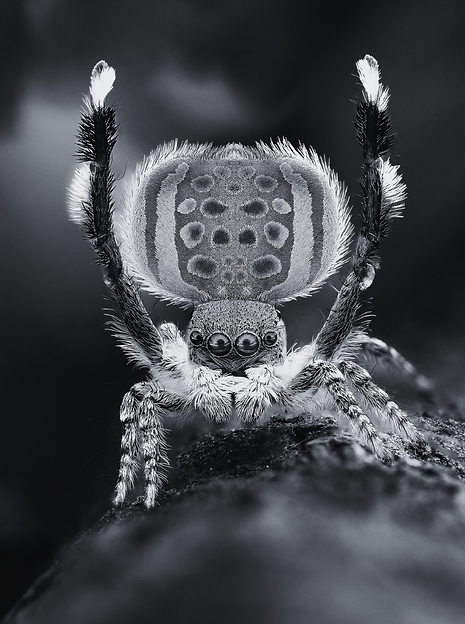
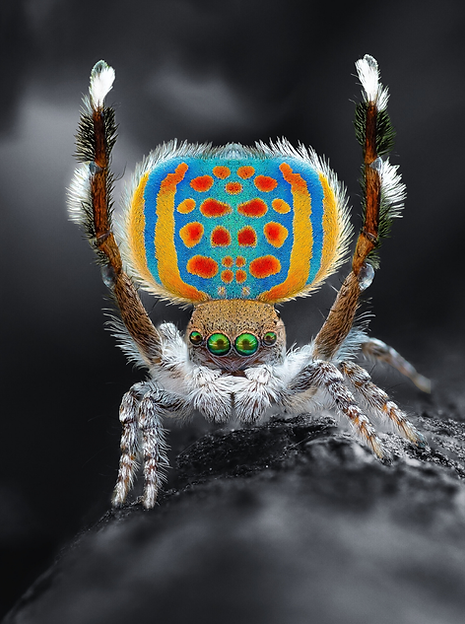
You might walk past them every day and never notice. Tiny. Colourful. Full of personality. Peacock spiders are Australia’s dancing jewels - no bigger than a fingernail, yet each male performs a mating dance that’s equal parts choreography and bravado.
Enter Michael. He’s spent years photographing and studying these tiny acrobats, learning patience, persistence, and the kind of fascination that makes you argue silently with something smaller than a coin because it refuses to strike the perfect pose.
This isn’t about Instagram snaps or pretty colours. It’s about noticing wonder where most people see a backyard, and letting curiosity become obsession.


Curiosity Meets Colour
Michael has always been drawn to the unusual. “As a four-year-old, I had an undying fascination with crabs - a curiosity that set the tone for the rest of my life.”
Peacock spiders caught his eye in 2012. “I saw a video of one performing its display. I was completely mesmerised. I assumed these incredible creatures lived somewhere far away, deep in exotic rainforests.”
Fast forward to Perth’s 2019 lockdown. No school. No routine. Just time to explore. Wandering his garden one afternoon, around 4 pm, sunlight hit a fence like a spotlight. And there it was: a peacock spider.
“That was the moment. Curiosity turned into passion. I truly saw something extraordinary in something so small. I was hooked.”
He started small -mum’s phone, then a borrowed Canon. Meeting Flynn Prall showed him what was possible. Weeks of convincing later, his mum said yes.
“As soon as my gear arrived, I practised relentlessly. Hour after hour. Day after day. Not because I had to, but because I loved it.”
Nightly research paired with fieldwork built what Michael calls “understanding.” His fascination isn’t just colour, it’s mystery. “Despite everything we’ve learned, there is still so much we don’t know. So many behaviours yet to be observed.”
Favourite species include Maratus madelineae, Maratus pardus, and Maratus pinniger. “Each one is unique. Each extraordinary. Even subtler species have their own beauty and purpose.”
Across Western Australia, he’s created memories to carry forever: spotting multiple species in a day in the South West, photographing Maratus constellatus in Kalbarri while sleeping under the stars.


starting small, observing big
Michael’s advice is simple: start.
“You don’t need perfect gear. You don’t need to know everything. Just curiosity and the willingness to learn. Practise. Experiment. Make mistakes. Grow. Passion isn’t built overnight it’s built through persistence, patience, and genuine love for what you do.”
Gear matters, but patience matters more. Spiders don’t perform on cue. Sunlight doesn’t behave. Fences rarely cooperate. Michael’s secret? Attention to detail and the willingness to make mistakes, small adjustments, careful observation, a lot of patience, turn fleeting displays into photos that tell a story.
Michael’s journey has been extraordinary: filming with Steve Backshall, contributing to projects connected with David Attenborough, and seeing his work on the cover of Australian Geographic.
“Moments I never could have imagined when I first spotted that tiny spider on my fence… as incredible as those milestones are, they’re not what matter most.”
“What matters most is the reason behind it all. The spiders. The natural world. The quiet, often overlooked beauty that exists all around us. These creatures were here long before us. And we have a responsibility to ensure they’re here long after us.”
“Passion has no age limit. Curiosity has no expiry date. Dreams are not reserved for the young. If something sparks your interest - no matter how small, no matter how unusual, lean into it. Nurture it. Protect it. Pursue it wholeheartedly. Give it your energy, your time, your belief. Because you never know where it might lead, what doors it might open, what purpose it might reveal. Keep your passions alive. They are what keep you alive.”
connect with michael

Wildlife will fascinate you.
The bush can captivate you. But let’s be honest: it can also trip you up, bite you, or send your plans sideways. That’s why the smart Aussies pack more than curiosity - they pack a kit that actually works when the unexpected shows up.


prepared,
not paranoid
Australia’s Favourite First Aid Kits
There’s a certain logic that comes with spending time in the Australian outdoors. You carry extra water. You check the weather twice. You keep a head torch in the glove box even when you swear you won’t need it. Not because you expect things to go wrong but because out here, being prepared is just a good habit. First aid kits sit in that same category. Unexciting. Unphotogenic. Absolutely essential.
Australia’s wildlife doesn’t need to be feared, Snakes don’t hunt down tourists. Spiders don’t pick fights. Most incidents happen when something unexpected interrupts an otherwise normal day - a misstep on a track, a startled animal, a long way from help. In those moments, preparation matters.
Enter SURVIVAL First Aid Kits.

when it counts
These kits are designed to help you react faster and stay calmer in emergencies. Each kit is laid out with intention. Components are clearly labelled with their name, use, and number, so there’s no rummaging or second-guessing. Colour coding does the thinking for you red for trauma, blue for hygiene, green for information, black for utilities. It’s a small detail that makes a big difference when adrenaline is high and time matters.
The kits themselves are compact, durable, and built for real-world conditions. They’re made to live in vans, backpacks, boats, utes and caravans, not just bathroom cupboards. MOLLE compatibility means they clip easily onto packs or gear, ready to go when you are.


the outdoor bundle
SURVIVAL’s best-selling Outdoor Bundle reflects that same practical mindset. It combines the Family First Aid Kit rated #1 by Choice Experts with the Snake Bite Kit and the Emergency First Aid Handbook. One stays in the car or caravan. The other comes with you when you leave it behind. It’s a system designed around how people actually move through the world.
What's inside:
-
Family First Aid Kit - Choice Experts #1 (2022), ideal for car or caravan, covers minor to major injuries.
-
Snake Bite Kit – Includes two SMART Bandages for snake, Funnel-web spider, Blue-ringed octopus, cone shell, sprains, fractures, and major bleeds when away from the car.
-
Emergency First Aid Handbook – Award-winning guide.

built for the bush
One of SURVIVAL’s standout tools is the SMART™ Bandage - a deceptively simple but genuinely clever piece of kit designed specifically for snake and funnel-web spider bites. The rectangular bandage turns into a square when the correct pressure is applied, taking the guesswork out of achieving the right compression. It’s first aid designed for real humans, not perfect conditions.
And while it’s best known for snake bites, the same kit covers a wide range of serious scenarios from spider bites, stings, sprains, fractures and major bleeds. It’s the kind of gear you hope stays zipped, but you’re glad to have when it doesn’t.
Every kit also features QR codes linking directly to restocking and to SURVIVAL’s free iFirstAid app . The app provides step-by-step instructions for a wide range of first aid situations and even pinpoints your GPS location using what3words, a quiet but powerful tool when you’re far from street signs and landmarks.

First aid knowledge saves lives.
SURVIVAL isn’t about trends. It started in 1988, when twin brothers Jerry and Tim Tyrrell turned personal tragedy into a simple belief: first aid knowledge should be accessible to everyone. What began as an award-winning handbook grew into life-saving kits and a platform for education. Now, the next generation carries it forward. Mike, Tim’s son, and his long-time mate Jordan have taken the reins - bringing fresh energy while staying true to the original purpose. Mike’s belief in preparation was tested in 2004, when he survived the Boxing Day tsunami in Thailand. Quick thinking and careful prep made the difference, proving the truth SURVIVAL has always stood by: first aid knowledge saves lives. More than 35 years on, over 100,000 Aussies, families, travellers, adventurers trust the brand. And beyond personal safety, every purchase removes 40 pieces of rubbish from the Australian landscape through SURVIVAL’s partnership with Outback Clean Ups Australia. Respect the wild. Take responsibility.
First aid kits aren’t about expecting the worst. They’re about giving yourself the best chance to respond calmly, clearly, and responsibly when it matters. Stuff you hope you never use but always pack anyway.
grab yours


Big or small, furry or scaly, slow or downright speedy,
Australia’s wildlife marches to its own beat. In this section, we’re tagging along with the guides and adventurers who’ve made it their business to meet the critters head-on, so you don’t just see the wild… you experience it.
WILD SIDE
EXPLORING AUSTRALIA'S
WITH AUSTRALIAN WILDLIFE ENCOUNTERS
Since 2015, Australian Wildlife Encounters has been turning the dream of getting close to Australia’s most elusive wildlife into a reality. Founded by Max Jackson and his longtime friend Lockie Gilding, the company grew out of a shared obsession with reptiles, mammals, and all things wild. The duo’s experience spans zoological facilities, conservation organisations, wildlife consultancies, and relocations.
“Introduced at 16 yrs old, our mutual passion for snakes and other reptiles soon had us spending all our spare time and money travelling across Australia, and then the world, in search of seeing and photographing as many species as we could,” Max explains. “Our goal has always been to find, see, and understand as much wildlife as possible and now we get to share that with others.”


the experience
Australian Wildlife Encounters specialises in custom private tours, crafted to suit each client’s dreams. Whether it’s an ambitious quest to tick off every Australian mammal species or a filming expedition to witness the Thorny Devil in the desert, no adventure is too big or too remote.
Some standout experiences include:
-
Inland Taipan Expedition: A two-week road trip for a client aiming to see the world’s most venomous snake in its natural habitat, traversing the blacksoil plains of far western Queensland. Along the way, participants encounter Perentie, Collett’s Black Snake, Olive Python, and more.
-
Kutini-Payamu National Park: A Cape York hotspot home to Green Pythons, Palm Cockatoos, Spotted Cuscus, Canopy Goannas, Eclectus Parrots, and Giant Tree Geckos.
-
Komodo Island Adventures: Guided tours to Indonesia in search of Komodo Dragons, exploring limestone caves for Timor Pythons, isolated islands for the sky-blue Sunda Pit Viper, snorkeling with Manta Rays, and visiting local villages living alongside these giants.
-
Venomous Snake Handling & Relocation Courses: Training for individuals or companies wanting to safely handle and relocate snakes, offered on the Sunshine Coast or across the state.
“Each tour is about more than spotting wildlife, it’s about understanding it. From rare reptiles to hidden mammals, we aim to give people an authentic, hands-on connection with the wild,” Lockie says.
from the field
The story of Australian Wildlife Encounters is one of passion, persistence, and plenty of road trips. Max and Lockie have chased wildlife across the country, often on a whim - Birdsville for a weekend? Done. Swag in the car for a spontaneous trip to Winton? Absolutely. Their adventures even stretch internationally, including assisting on a Burmese Python conservation project in Bangladesh.
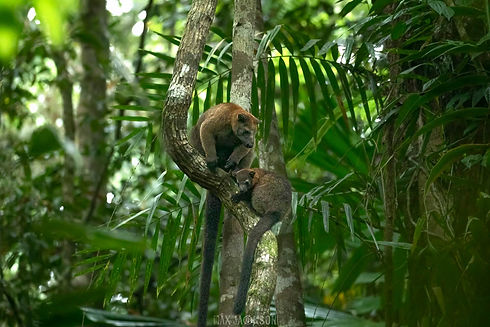
A favourite memory comes from searching for the elusive Bennett’s Tree Kangaroo with an avid mammal-watching client. Often called the “unicorn of the rainforest” due to its rarity, the team dedicated three days solely to finding it. Using binoculars and thermal monoculars, they spotted a family of three just before dawn on their last day, while a Cassowary wandered past 10 meters away.
“It’s these moments that I enjoy most as a guide, the adrenaline rush when you encounter a target species in the wild is like nothing else. Especially when it’s a species that you have dedicated a
lot of time and energy into searching for,” Max recalls.
Over the years, their expertise has grown to include mammals, birds, and frogs, expanding beyond their original reptile focus. Every tour combines careful research, passion, and insider knowledge to ensure clients leave with unforgettable wildlife experiences.


Whether it’s a scaly, furry, or feathered encounter
the bush has a way of keeping you guessing and loving every second.
a life in the

wild

Exploring Australia’s Top End with David McMahon
Originally from Adelaide, David McMahon’s journey into Northern Australia was fueled by a lifelong fascination with the bush, its wildlife, and its people. Trading the kitchen for the wilderness, his early career as a fine dining chef now informs his unique approach to expedition “bush tucker,” blending gourmet skill with native ingredients. Over 16 years in the Top End, David has developed a deep respect for Indigenous culture and Australia’s extraordinary biodiversity.
“What started out as a drive through the desert, up into the tropics to seek out some adventure has turned into a lifelong passion for the bush and sharing the knowledge I've acquired with enthusiastic guests.”
a day in the top end
A typical day with David is far from predictable. Mornings might begin with treks to ancient rock art sites, followed by coastal forays in search of mud crabs or oysters. No two days are the same, with the Top End’s landscapes offering surprises at every turn.
As head guide for Northern Safaris, David balances wildlife encounters, cultural immersion, and environmental education.
“We focus on slow tourism,” he explains. “Taking guests off the beaten track and connecting them with restricted areas often alongside Indigenous guides gives people a real connection to Country and its stories.”


wildlife and bush-to-plate adventures
For David, the most rewarding moments come from connecting guests with the land and its wildlife. Northern Australia teems with extraordinary species, and he uses these encounters to educate visitors, helping them appreciate wildlife without fear and inspiring awe for creatures they might otherwise overlook.
Drawing on his chef background, David delivers bush-to-plate experiences, preparing native ingredients under the stars while sharing the stories behind each meal. These culinary moments highlight the deep link between food, land, and wildlife, giving guests a sensory and cultural understanding of the Top End.
cultural connections in the top end
David’s decades-long relationships with Aboriginal communities allow him to respectfully share cultural knowledge, giving guests a deeper connection to Country.
“My aim guiding is to share my infectious enthusiasm for all things wild with guests from around the world and have them walk away understanding the bush in a deeper way than when they started the tour,” he explains.
Through this combination of cultural insight and immersive experiences, each expedition becomes more than a tour - it’s a journey into the richness of the Top End.


gear discounts


SMELLY BALLS
REUSABLE AIR FRESHENERS THAT TRAVEL WELL
Say goodbye to single-use car fresheners. Smelly Balls are reusable, refillable, and made for the long haul. Perfect for cars, campers, tents, or any cosy corner. Just add your favourite scent, hang them up, and refresh whenever the mood strikes.
Crafted from premium felt and backed by a mission to support women workers in Nepal, they smell good, look good, and do good. Roadtrip essential? Absolutely.
15% OFF EVERYTHING


FLOATABLES
REDEFINING LIFE ON THE WATER
Floatables is all about levelling up your time on the water. Think inflatable docks, water hammocks, and wellness ice baths designed for adventure, relaxation, and serious durability. Proudly Australian-owned, we create premium, multi-purpose gear built for sun-soaked days, crystal-clear dips, and unforgettable moments. This isn’t just gear—it’s a lifestyle.
10% OFF SITEWIDE


MOGU OUTDOORS
CAMP SMARTER. ROAM FREER.
At Mogu Outdoors, we make smart, easy-to-use gear that takes the hassle out of camping, so you can get straight to the good stuff. Cooking, exploring, and kicking back under the stars. Designed in Australia for adventure-lovers everywhere, our gear keeps things simple, stylish, and built to last.
From space-saving kitchen kits to rugged tool bags and seriously comfy sleeping gear, everything we make is about improving your outdoor setup without overcomplicating it. Less faff, more freedom. Because when your gear works as hard as you do, the only thing left to focus on is the adventure.
10% OFF SITEWIDE

ROAMING FOLK
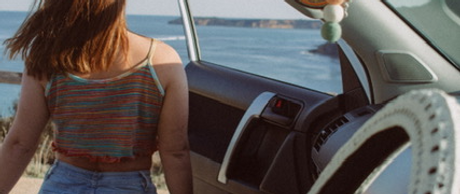
Roaming Folk creates handcrafted crochet car seat and steering wheel covers that bring bohemian charm to every drive. Designed in Australia and handmade by skilled Indonesian artisans, each piece is a one-of-a-kind blend of comfort, style, and craftsmanship - perfect for those who roam with intention.
15% OFF ALL PRODUCTS


Roam Gear
We're a passionate Aussie brand with everything you need for off-grid adventures. From premium 12-volt solar gear and accessories to camping essentials, we're your one-stop shop to hit the road. With years of industry experience, we offer the equipment and expert advice to help you live the #roamlife. Get ready to roam and explore our range of outdoor gear today!
15% OFF SIDEWIDE


BOK BEACH LIFE
ENDLESS SUMMER ESSENTIALS
Bok Beach Life is all about good vibes, great design, and gear that makes beach days better. From sand-free towels made with recycled plastic to laid-back essentials built for sunny days, we blend sustainability with style, so you can enjoy the coast while helping protect it.
20% OFF ENTIRE ORDER


BARKIN BOARDS
Barkin Boards was born from one simple truth: surfboards shouldn’t cost a fortune. We cut out the middlemen, source from the same factories as the big brands, and pass the savings straight to you. Same quality, better prices, because surfing should be fun, not financially painful. Woof.
10% OFF MINI MALS


VANILLA MOZI
The innovative Vanilla Mozi Outdoor range includes the award winning Body Cream, Soy Wax Candles and Soy Wax Melts in a Vanilla & Spearmint scent. Suitable for babies and highly sensitive skin, the trending products are natural, organic and vegan. They are also free from palm oil and parabens.
15% OFF SELECT PRODUCTS

%20(2).png)
ohana pups
Ohana Pups crafts consciously made goods for beach-loving dogs and their owners. Inspired by a love of coastal living, their bestselling leather collars are handmade with non-toxic tanning, natural cowrie shells, and premium brass - built to last through countless golden adventures.
10% OFF SITEWIDE


WIZARD FIREPITS
Wizard Fire Pits creates premium smokeless fire pits for people who love entertaining outdoors. Wizard Fire Pits are sleek, stainless steel, and engineered for high performance with little to no smoke. From backyard hangouts to romantic nights under the stars, we make fire simple, stunning, and smoke-free.
10% OFF SELECT PRODUCTS
We're all about giving back to the legends who support us. So we've got a massive gift for you!
Subscribe completely free and you’ll instantly unlock our exclusive Roam Legend Membership and get discounts on over 4,000 adventure experiences!
here's what you get:
epic discounts
Adventure experiences , cool stays, 4x4 accessories, camping gear, surfboards, beach gear, even mosquito repellent and dog accessories!
Win
cool Sh*T!
Enter every giveaway, every month.
Automatic entry to every competition!
And it's free!


Grab a Bottle. Protect the Wild.
$10 from every purchase supports Wildlife Rescue Queensland’s vital work.


1.1L Roam wilder Bottles
$49.99
-
Keeps ice cold for up to 24 hours
-
Keeps liquids hot for up to 24 hours
-
BPA FREE
-
Kitchen Grade 18/8 Steel
-
Double-Walled Insulation Technology
-
Dishwasher Safe
We donate $10 from every bottle sold to Wildlife Rescue Queensland.
Broken River, Eungella National Park:
platypus paradise
If you’ve ever wanted to catch a glimpse of one of Australia’s most secretive creatures, Broken River in Eungella National Park is the place to be. Nestled in lush rainforest, this calm, crystal-clear waterway is famous for its platypus population. Arrive early or late in the day, move quietly, and you might just see them gliding effortlessly through the water a rare wildlife moment that feels like your own private nature documentary.


Where: Broken River, Eungella National Park, QLD
Best Time: Dawn or dusk for platypus spotting
Parking: Small car park near Broken River Visitor Area
Cost: Free entry to the park (standard QLD National Park fees may apply)
Facilities: Boardwalks, picnic areas, BBQs
Roam Tip: The boardwalk near the Broken River Visitor Area is the sweet spot. Stand quietly along the railings, scan the water, and be patient these shy mammals don’t rush. Pair it with a stroll through the rainforest to spot kingfishers and other birdlife along the banks.
.png)

Into the Night
Daytime wildlife gets plenty of attention, but the night crew deserves a look in too. When the sun drops and the mozzies clock on, thousands of wings take to the sky.

with Ecologist Jasmine Vink
the night shift
Inside the world of Bats
As dusk falls over Far North Queensland, thousands of wings begin to stir. For wildlife ecologist Jasmine Vink, this is when the real work begins.
Based near Cairns, Jasmine has been professionally involved with bats for around a decade. After completing a Bachelor of Science and working on ecological projects across Australia, she found herself drawn deeper into working professionally with bats, particularly flying foxes.
“I always knew I wanted to work with wildlife,” she says. “But once I started working with bats, I completely fell in love with them.”
That fascination led her to join her local bat rescue group, where she began rescuing, raising and rehabilitating bats - particularly flying foxes. Today, she balances hands-on rehabilitation with advocacy, recently co-founding Flying Fox Advocates QLD (FFAQ) to campaign against the legal shooting of flying foxes in Queensland.
She is also a multi-award-winning wildlife photographer, specialising in bats and other threatened, secretive species - using imagery to challenge fear-driven narratives.
what bat rehabilitation really looks like
Before anything else, Jasmine stresses one key point: members of the public should never touch bats. She is trained, highly experienced, and vaccinated against Australian Bat Lyssavirus (ABLV). If someone encounters an injured bat or one alone during the day, the correct response is to contact a licensed wildlife rescue group.
Bats typically enter care via public rescue calls or active colony monitoring during peak seasons. Jasmine responds to local rescues and works closely with Tolga Bat Hospital, transferring severe paralysis tick cases to their specialist facility.
Orphaned pups and non-critical cases are rehabilitated at her home, while severe paralysis tick cases are transferred to Tolga Bat Hospital. Inside a dedicated “bat room” are humidicribs, oxygen concentrators and medical enclosures for critical patients. Once strong enough, bats graduate to a 10-metre outdoor flight aviary to rebuild fitness before release.
The goal is always the same: fully wild bats, ready to return to the sky.


An Endangered Neighbour
The primary species Jasmine rehabilitates is the spectacled flying fox, a federally endangered species found predominantly in the Wet Tropics.
Flying foxes are vital long-distance pollinators and seed dispersers. Insectivorous bats consume up to 40% of their body weight nightly in insects, including agricultural pests. Without bats, ecosystems begin to unravel. Yet they remain widely misunderstood.
“They’re exceptionally intelligent and social animals,” Jasmine explains. In the wild, mothers are affectionate and attentive, behaviour carers must carefully emulate when raising orphaned pups. Young bats require comfort and tactile bonding, but strict protocols ensure they are fully dehumanised before release.
Given that spectacled flying foxes can live 15–20 years in the wild, even a few months in care can mean decades of ecological contribution.


Rescue,
Rehab,
Release
One of the greatest threats to spectacled flying foxes in FNQ is paralysis ticks. Due to land clearing and invasive weeds, bats are feeding lower in the canopy, bringing them into contact with venomous ticks, which the bats haven’t evolved resistance to because they normally feed high in the canopy.
Each spring and summer, Jasmine assists with colony monitoring. Some days only a handful are rescued; other days, over a dozen.
Barbed wire entanglement is another devastating issue. Flying foxes can’t see fences at night, especially in fog or wind. Recently, mass entanglements saw over 200 little red flying foxes caught across several fences in just weeks. In one morning, Jasmine rescued more than 30 bats though many injuries were too severe to save.
Thankfully, high-visibility tape has since been installed on those fences, preventing further tragedies. 80 bats bats from that incident were rehabilitated and released, 20 of those were personally rehabbed by Jasmine.

The look book

Changing Perceptions
One of Jasmine’s favourite species is the eastern tube-nosed bat, a tiny fruit bat weighing just 50 grams, with tubular nostrils used to scent directionally. Camouflaged in foliage, they even sway like leaves in the breeze when disturbed.
“These little bats have an incredible ability to heal,” she says.
Unfortunately, most come into care due to barbed wire entanglements.
For those inspired to get involved, the first step is joining your local wildlife rescue group. Some regions have bat-specific organisations; others operate within broader wildlife networks. Anyone working with bats must be vaccinated against Australian Bat Lyssavirus (ABLV) and complete appropriate training.
From rescue call-outs to raising orphaned pups, there are ways to contribute at every level.


turning passion into action
Across Australia there is tireless work being done to ensure the species we love remain to be appreciated.

holding the line
Inside the Conservation Work of Aussie Ark
In the Barrington Tops of New South Wales, conservation isn’t theoretical - it’s operational. Aussie Ark is a conservation-action organisation built on what works, and now in its 15th year, it has grown into the state’s largest independently owned and operated conservation organisation.
At the heart of its work is a 400-hectare sanctuary where threatened species are bred, protected and prepared for return to the wild. From critical breeding programs and rewilding initiatives to managing the Barrington Wildlife Sanctuary, a 75-hectare Eco Sanctuary, a dedicated Species Recovery Unit and Conservation Ark on the NSW Central Coast, the focus is consistent: build robust insurance populations and strengthen ecosystems before they reach breaking point.


beyond good intentions
The results are measurable. Aussie Ark currently protects 18 threatened species, has bred 3,186 animals, rewilded 228 individuals, planted 48,000 trees and protected more than 3,500 hectares of land. These aren’t just symbolic milestones, they represent years of sustained, hands-on recovery work.
The organisation operates Australia’s largest mainland breeding facility for disease-free Tasmanian Devils, safeguarding a critical insurance population. Among its major achievements are the successful breeding and release of Eastern Quolls and endangered turtle species back into natural habitat, directly contributing to genetic diversity and long-term survival in the wild.


the people behind the work
Aussie Ark was founded by Tim Faulkner, who continues to lead the organisation as Managing Director, alongside Deputy Managing Director Liz Gabriel. Together, they’ve built a team of conservationists, rangers and operational staff committed to practical, long-term recovery, not short-term headlines.
Behind every breeding program and rewilding effort is daily, often unseen work: habitat management, monitoring, species care and coordination across multiple sites. It’s steady, disciplined conservation, the kind that prioritises outcomes over optics and keeps threatened species moving away from the edge.

get involved
There are tangible ways to support that work. Donations directly fund conservation projects across all 18 threatened species, while species adoptions contribute to the care and protection of individual animals. The Aussie Ark shop also feeds directly back into breeding and rewilding programs.
For those travelling through the Barrington Tops region, the support becomes more immersive. Visitors can book a Devils in the Wild Tour or attend select Open Days, experiencing the sanctuary firsthand while contributing to its ongoing protection efforts.

wildlife doesn't operate in silos
Zoom out and you'll see something bigger - a web of relationships where every arrival and departure leaves a mark.
LIFE ON LADY MUSGRAVE ISLAND
A PERFECT LOOP
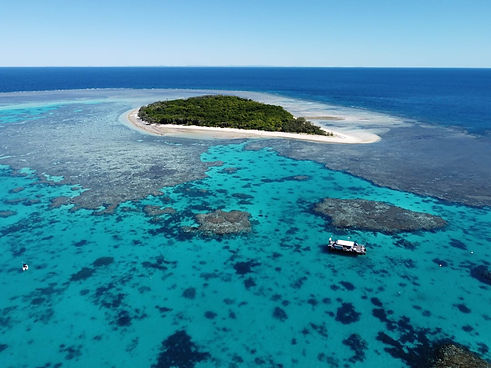
Lady Musgrave Island sits at the southern tip of the Great Barrier Reef - a coral cay edged by bright lagoon water and crowned with dense green forest. On paper, it’s a simple equation: coral sand, seabirds, trees.
In reality, it’s a tightly woven exchange.
Coral cays are formed from broken coral and sand. They’re striking to look at, but naturally low in nutrients. Left alone, they struggle to support the kind of thick forest that now dominates Lady Musgrave’s interior. What changes the equation here isn’t what grows from the ground - it’s what arrives from the sky.
Each year, thousands of seabirds return to nest. Black noddies settle into the branches. Wedge-tailed shearwaters burrow into sandy pockets beneath the trees. The island fills with movement, sound and, most importantly, nutrients carried in from the sea.
The birds feed offshore, then come back to land. Over time, their guano, rich in nitrogen and phosphorus seeps into the coral sand below, gradually transforming it. What begins as nutrient-poor substrate becomes soil capable of supporting a forest.
The forest shelters the birds.
The birds sustain the forest.
Nothing here operates in isolation.


THE STICKY STRATEGY
At the centre of the island’s canopy stands Pisonia grandis, often called the “birdcatcher tree.” The nickname suggests something sinister, but the biology is far more practical.
Pisonia produces elongated seed pods coated in a sticky resin. The idea is straightforward: attach to feathers, hitch a ride to another island, drop off, grow. For a tree rooted on a remote cay, it’s an effective way to travel.
Most of the time, birds remove the seeds while preening. The system works.
But in dense nesting colonies, especially during breeding season the numbers shift. Seeds can build up. A few pods turn into dozens. Wings become heavier. Chicks, still awkward and inexperienced, are more vulnerable.
Some birds don’t survive the season.
Not because the tree is designed to kill, but because in crowded systems, even good strategies can have side effects.
And here, even that becomes part of the cycle.
NOTHING WASTED
When a bird dies beneath the Pisonia canopy, it doesn’t sit outside the ecosystem, it re-enters it.
Coral sand alone cannot sustain long-term forest growth. But seabird colonies change soil chemistry over time. Guano provides a constant nutrient supply. Decomposition adds further organic matter. Together, they build fertility where very little existed before.
That fertility supports stronger trees.
Stronger trees create better nesting habitat.
Better nesting habitat attracts more birds.
Ocean to fish.
Fish to bird.
Bird to soil.
Soil to forest.
Forest back to bird.
What looks like a peaceful coral island is actually a functioning loop reef and cay connected through wings and roots. Each generation of birds nests in branches grown from nutrients delivered by the ones before them.
On this strip of coral sand, survival is a shared effort.


beyond the shore line
Some of the strangest wildlife stories are happening beneath the surface.
Close to Shore, Far from Ordinary:
The Secrets of our fringing reefs with Lawrence Sheele
Magnetic Island sits within the Great Barrier Reef, edged by shallow fringing reefs that most visitors wade over without a second thought. For Lawrence, those inshore systems are everything.
Based on Magnetic Island, Lawrence is an independent marine biologist and author focusing on cephalopods and inshore fringing reefs. For as long as he can remember, he’s been fascinated by the ocean, particularly octopus. That early obsession led him to study Marine Science, later to work with National Geographic, and eventually return to a more focused path: documenting the lesser-known marine life living close to shore.
While the outer reef captures global attention, Lawrence has chosen to concentrate on the reefs hugging the coastline, shallow and accessible systems often overlooked but rich in biodiversity.
“They’re right there,” he says. “People just don’t realise what they’re looking at.”


a day on the fringe
A typical field day begins simply: snorkelling, diving or tide pooling the fringing coral reefs surrounding Magnetic Island.
Lawrence and his team survey for cryptic species, animals easily missed due to camouflage, nocturnal habits or size. Each sighting is photographed and recorded. Many represent first records for the region, and occasionally they document species never before recorded on Australia’s east coast.
Back on land, hours are spent processing images and video, logging data and organising material for research projects, documentary films, fine art prints and marine conservation work.
If the conditions are still favourable, the day extends into night.
Night dives focus on rare nocturnal species - the reef changes once the sun disappears. Creatures that spend daylight hours buried or hidden begin to move.
“You see a completely different reef at night,” Lawrence explains. “Species you’d never know were there suddenly appear.”
Discovery in these waters isn’t always rare. It’s just often overlooked.

the weird, the wonderful, and
The Unexpected
Among the most remarkable seasonal visitors is the Winged Box Jellyfish (Alatina alata), a species found throughout tropical waters worldwide. It typically appears 8 - 10 days after a full moon, forming spawning aggregations in shallow coastal areas.
A sting results in Irukandji syndrome and requires emergency treatment. During one survey, a dive buddy was unknowingly stung. The sting itself was painless, with symptoms developing around 40 minutes later.
“Now we expect to see them during that particular lunar cycle,” Lawrence says. The reef, it turns out, keeps a schedule.
Then there’s the Red Spot Night Octopus (Callistoctopus dierythraeus), a cryptic and nocturnal species found only in tropical and subtropical Australia. During the day, it burrows deep underground in carefully constructed dens made from coral rubble. At night, it emerges to feed, often seen carrying cockles back to its den. When threatened, it inverts its resting colour scheme, displaying a white body marked with red spots.
The tiny sea slug known as “Shaun the Sheep” (Costasiella kuroshimae) grows to just one centimetre and exclusively inhabits the green algae Avrainvillea. By absorbing the algae’s chloroplasts, it can harvest energy from sunlight, effectively becoming solar powered.
The Violet Sea Apple (Pseudocolochirus violaceus), a vividly coloured sea cucumber, inhabits seagrass and sandy areas. It feeds by extending numerous branched oral tentacles to catch organic matter and draw it into its mouth.
Occasionally, the team encounters the elusive Australian Snubfin Dolphin (Orcaella heinsohni), found only in coastal Northern Australia and Papua New Guinea. Unlike most dolphins, it lacks a beaked snout and has a rounded head.
These dolphins cooperatively hunt by spitting jets of water to herd fish into tightly packed groups. They are shy and rarely seen.
All of this life exists metres from shore.
protect what you know
Inshore fringing reefs sit closest to human activity and face significant pressure because of that proximity.
For Lawrence, awareness is fundamental to protection.
“People aren’t going to protect what they don’t know.”
That belief drives his current work. He is touring his documentary Hidden Treasure: Magnetic Island alongside his book, A Field Guide To The Marine Life Of Magnetic Island, Great Barrier Reef. Over the next five years, he will work with fish expert Dr. Daniela Ceccarelli to catalogue and create a dedicated fish guide for Magnetic Island through the Magnetic Island Community Development Association (MICDA). He has also recently contributed to the development of an Important Shark & Ray Area (ISRA) for Magnetic Island.
By documenting what exists on these inshore reefs through research, film and field guides Lawrence hopes to make the unseen visible.

until next time, legends
From raptors overhead to platypus doing its best disappearing act, this issue reminded us that the wild is closer than you think… and way more entertaining.
Whether you’re bushwalking, snorkelling, or just sneaking a peek at your local creek, keep your eyes open, The good stuff’s always in the details.
Until Next Time, Legends…